When Will Ohio Turn Into a Rainforest Again
Abstract
The resilience of the Amazon rainforest to climate and land-use change is crucial for biodiversity, regional climate and the global carbon bicycle. Deforestation and climate change, via increasing dry out-season length and drought frequency, may already have pushed the Amazon close to a critical threshold of rainforest dieback. Here, we quantify changes of Amazon resilience by applying established indicators (for case, measuring lag-one autocorrelation) to remotely sensed vegetation data with a focus on vegetation optical depth (1991–2016). Nosotros find that more than 3-quarters of the Amazon rainforest has been losing resilience since the early 2000s, consistent with the approach to a critical transition. Resilience is being lost faster in regions with less rainfall and in parts of the rainforest that are closer to man activeness. Nosotros provide direct empirical bear witness that the Amazon rainforest is losing resilience, risking dieback with profound implications for biodiversity, carbon storage and climate change at a global scale.
Principal
There is widespread business concern about the resilience of the Amazon rainforest to country-employ change and climate change. The Amazon is recognized as a potential tipping element in the Earth's climate arrangement1, is a crucible of biodiversitytwo and ordinarily acts as a large terrestrial carbon sink3,iv. The internet ecosystem productivity (carbon uptake flux) of the Amazon has, still, been failing over the concluding four decades and, during ii major droughts in 2005 and 2010, the Amazon temporarily turned into a carbon source, due to increased tree bloodshed5,vi,vii. Several studies have suggested that deforestationeight and anthropogenic global warming9,10, especially in combination, could push the Amazon rainforest past critical thresholdsxi,12 where positive feedbacks propel abrupt and substantial further forest loss. Two types of positive feedback are particularly of import. First, localized fire feedbacks amplify drought and associated forest loss past destroying trees13 and the fire regime itself may 'tip' from localized to 'mega-fires'xiv. 2nd, deforestation and forest degradation, whether due to direct human intervention or droughts, reduce evapotranspiration and hence the wet transported further westward, reducing rainfall and wood viability therefifteen and establishing a large-scale moisture recycling feedback. Net rainfall reduction may in turn reduce latent heating over the Amazon to the extent that it weakens the depression-level circulation of the South American monsoon8. Model projections of future changes in the Amazon rainforest differ widelyix,16,17,eighteen. Early on studies showed that the Amazon rainforest may exhibit strong dieback by the end of the twenty-first century9,19. Both pronounced drying in tropical South America and a weak CO2 fertilization effect18 contributed to this result, with dieback also more common nether stronger greenhouse gas emission scenarios17. Other studies based on varying general circulation and vegetation model components show a wider range of results20,21. Nevertheless, the forest may be 'committed' to dieback despite appearing stable at the end of model runs16. This highlights the importance of measuring the changing dynamic stability of the forest alongside its mean country. Given the dubiousness in model projections, we direct analyse observational data for signs of resilience loss in the Amazon.
The hateful country of a arrangement is not commonly informative of changes in resilience; either one can change whilst the other remains abiding16,17. Thus, college-order statistical characteristics that respond more sensitively to destabilization than the hateful need to exist considered to quantify resilience. To measure the changing resilience of the Amazon rainforest, nosotros utilise a stability indicator used to predict the approach of a dynamical arrangement towards a bifurcation-induced disquisitional transition. The predictability arises from the phenomenon of critical slowing down22,23 (CSD): as the currently occupied equilibrium state of a system becomes less stable, it responds more sluggishly to curt-term perturbations (for example, weather variability for the Amazon). This loss of resilience, which is itself typically divers24 as the return charge per unit from perturbations, reflects a weakening of negative feedbacks that maintain stability. The behaviour can be detected by an increase in lag-1 autocorrelation (AR(1)) in fourth dimension serial capturing the system dynamics25,26. It may besides manifest every bit an increase in variance over time but variance can also exist easily influenced past changing variability of the perturbations driving the system27. Increasing AR(1) has been used to find CSD earlier bifurcation-induced state transitions in a number of systems, including merely not express to climate25,28 and ecology29. In detail, CSD has recently been detected in reconstructions of western Greenland ice sheet superlative changesthirty as well every bit of the variability of the Atlantic Meridional Overturning Circulation31. A caveat, highlighted past analysis of model projections earlier Amazon dieback27, is that a system should exist forced slower than its intrinsic response time scale for CSD to occur (Methods). Hence, the absence of CSD may not rule out the possibility of a forthcoming critical transition. Conversely, increasing AR(1) tin can sometimes occur for other physical reasons. A infinite-for-fourth dimension commutation has previously revealed that tropical forest resilience as measured by mean AR(1) (on a filigree cell footing) is lower for less annual rainfall sums32 but changes of Amazon resilience over time have not been investigated so far.
We investigate controls on the resilience of the Amazon vegetation organization and how its resilience has changed over the last three decades, in terms of a changing AR(one) coefficient every bit estimated from satellite-derived vegetation data. For comparison, nosotros also investigate changes in variance over time, as a secondary indicator for CSD. The master dataset we utilise is from the Vegetation Optical Depth Climate Archive (VODCA)33 but we too analyse the NOAA Advanced Very-High-Resolution Radiometer's (AVHRR) Normalized Difference Vegetation Index (NDVI)34 for comparison. Vegetation optical depth (VOD) has been previously used to estimate changes in vegetation biomass35, whereas NDVI is more than commonly used to measure out the greenness of vegetation (that is, photosynthetic activity36), which can saturate at dense grass encompass. VOD, a microwave-derived product, does not saturate and remains sensitive to changes also at high biomass density35. We use the longer, Ku-band product from VODCA, which has a resolution of 0.25° × 0.25°, from which we create a monthly dataset by taking the mean values and for direct comparison we rescale the NDVI information to the same resolution. For a check of robustness, we too use the C-band production from VODCA, which spans a shorter time period. We focus on two stressors of the Amazon that may cause resilience changes—precipitation decline and human influence.
Results
We utilize the Amazon basin as our study region and focus on those grid cells that have a ≥lxxx% evergreen broadleaf (BL) fraction according to the MODIS Land Comprehend Blazon product in 200137 (Methods). Figure one shows that mean changes in BL fraction in this region correspond well to changes in VOD. Averaged beyond the Amazon report region we find overall decreasing VOD over 2001–2016, corresponding to the observed decrease in the number of grid cells that have BL ≥ 80% each yr (Fig. 1a). Between 2001 and 2016, the BL fraction has inverse most prominently in the south-eastern parts of the Amazon basin, along parts of the Amazon River and in some northern parts of the basin (Fig. 1b). Changes in VOD have a similar spatial pattern to changes in BL fraction, with decreases concentrated effectually the south-eastern edges of the forest (Fig. 1c). NDVI, in contrast, does not agree temporally or spatially with the changes in BL fraction (Supplementary Fig. 1), with NDVI increases observed in the south-eastern parts of the Amazon where deforestation rates are known to be highest. On the private filigree jail cell level, changes in BL are strongly correlated with changes in VOD (Pearson's r = 0.556; Supplementary Fig. 2a) compared to changes in NDVI (r = −0.133; Supplementary Fig. 2b). This echoes previous in-situ comparisons betwixt VOD and NDVI38. Hence, we focus our analysis on VOD in the following, with results for NDVI in the Supplementary Figures.
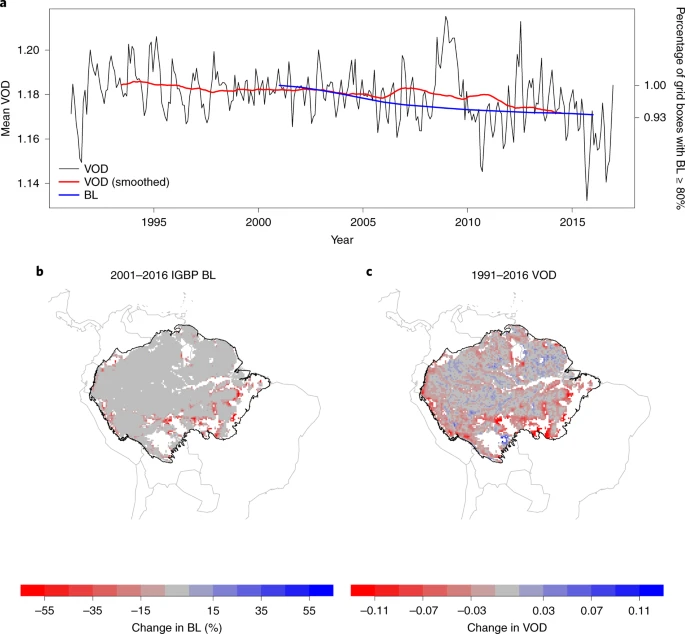
a, Fourth dimension serial of MODIS Land Encompass evergreen BL fraction and VODCA Ku-band product. Changes in BL fraction expressed every bit the pct of grid cells that have BL fraction ≥fourscore% in each year, compared to the number of grid cells that had BL fraction ≥80% in 2001, and VOD is the monthly mean. b, Changes in the BL fraction from 2001 to 2016 for grid cells where the BL fraction is ≥80% in 2001. c, Changes in VOD from 1991 to 2016 (divergence between the 2012–2016 and 1991–1995 means) for the grid cells where the BL fraction was ≥eighty% in 2001. State outlines were provided by the 'maps' bundle in R and Amazon basin outline was created from http://worldmap.harvard.edu/data/geonode:amapoly_ivb (Methods).
We begin our resilience analysis by focusing on the temporal changes of AR(1), computed in sliding windows from the nonlinearly detrended and deseasonalized VOD time series (Fig. ii and Methods). We remove forested (BL ≥ 80%) grid cells that have any human land use in them (Methods), resulting in 6,369 grid cells being analysed. The spatial distribution of the AR(1) tendency, measured by the Kendall's rank correlation coefficient τ (Methods) at each filigree cell, shows that the AR(ane) increases in most of the grid cells comprising the Amazon rainforest (Fig. 2a,b). Likewise, the fourth dimension series calculated from the hateful AR(1) value across our study expanse each month shows a substantial increase over time, particularly from the early 2000s (Fig. 2c). We observe some stable or decreasing AR(1) values around the tributaries of the Amazon River, suggesting increasing resilience. VOD values tin can be influenced by open water only this should exist minimized by looking only at grid cells where BL ≥ eighty%. Previously, floodplain forests well-nigh the river, which cover 14% of the basin, have been shown to be much less resilient than the non-flooded forests throughout the Amazon39. Still, when we compare grid cells in the Amazon basin floodplains and those outside (Methods), nosotros find no significant differences between the resilience signals (Isle of man–Whitney U-test P = 0.579), except for a smaller Kendall τ value for floodplains from 2003 onwards (0.863 compared to 0.915; Supplementary Fig. 3).
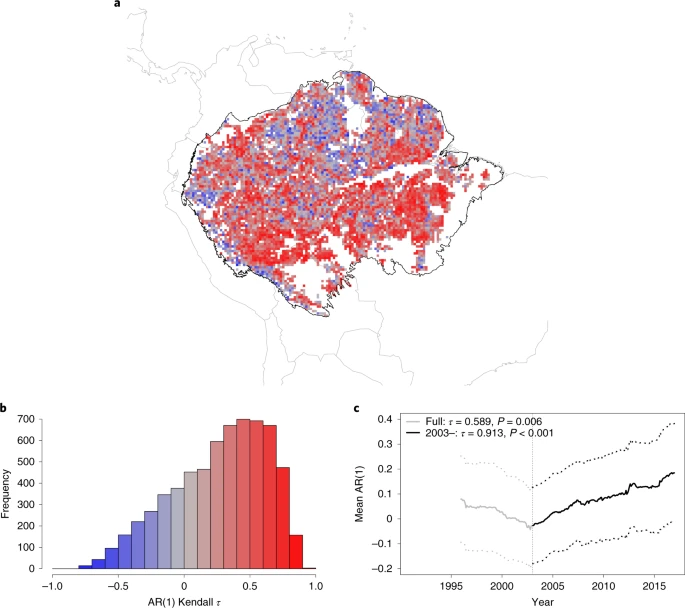
a, A map of the Kendall τ values of individual grid cells from 2003. b, Histogram of the Kendall τ values for the Amazon rainforest, considering data from 2003 onwards. Of the grid cells, 76.2% take a positive Kendall τ value from 2003 onwards and 77.eight% accept this for the full time series. c, Mean VOD AR(i) fourth dimension series (solid line) along with ±1 due south.d. (dotted lines) created from grid cells that have BL fraction ≥lxxx% in the Amazon bowl and also incorporate no man land utilize (main text and Methods). The full AR(1) time series from 1991 (gray) has a Kendall τ value of 0.589 (P = 0.006) and from 2003 (blackness), a value of 0.913 (P < 0.001). Note that the AR(1) values are plotted at the cease of each 5-yr sliding window. Land and Amazon basin outlines produced as described in Fig. 1.
Overall, most (76.ii%) of the grid cells show increasing AR(1) values from the early 2000s onwards and hence, loss of resilience (Fig. 2b), as well equally 77.8% of grid cells over the full time flow. Using alternative methods of detrending the VOD time serial (Methods) yields similar results (Supplementary Figs. 4 and 5), as does varying the window length used to judge AR(1) (Supplementary Fig. 6). The results are also robust to the choice of the BL fraction threshold used to decide forest, finding increasing AR(1) also when either BL ≥ 90% or BL ≥ xl% is used (Supplementary Fig. 7). Furthermore, restricting the assay to those grid points that have BL ≥ 80% through the flow 2001–2016, rather than but checking grid cells for BL ≥ 80% in 2001, shows similar signals of resilience loss (Supplementary Fig. 8). A predominance of increasing AR(1) trends is as well constitute for the NDVI fourth dimension series since 2003 (Supplementary Fig. 9).
To effort and determine the causes for the detected resilience loss across the Amazon basin, we explore the relationships between the AR(1) trends and mean annual precipitation (MAP, estimated from the CHIRPS dataset40), as well as between the AR(1) trends and the altitude from human being land utilise (Methods). Information technology has previously been suggested that drier forest is less resilient32 as well as woods nearer man land use41. We also include distance from roads alongside state use but this restricts the domain of analysis to Brazil to avoid biases by heterogeneities in road information across dissimilar countries (Supplementary Fig. 10; Methods). Effigy three compares the spatial patterns of the AR(1) trends, MAP and man state use. Relationships with both explanatory variables are discernible, with (less common) decreases in AR(ane) (Fig. 3a) being institute in regions of loftier MAP in the north of the region (Fig. 3b) and further abroad from human being land utilize (Fig. 3c). We find no misreckoning relationship between MAP and man land use; they are only very weakly correlated with each other (Spearman'due south ρ = 0.057, P < 0.001). Hence, we can consider them equally separate relationships. The computed minimum distances to human land use and roads should be interpreted as upper premises considering for the full region we do not include roads, and for the Brazil distances our dataset will not include non-federal or non-state roads, which also have human activeness associated with them. Furthermore, the nomenclature of grid cells that contain man land apply at the spatial resolution used in this assay is probable to only detect big farms and settlements.

a, VOD AR(1) Kendall τ values (as in Fig. 2a). b, MAP from the CHIRPS dataset from 1991 to 2016. c, Altitude from human state use (HLU) (Methods). In a–c, MAP contours are shown, along with HLU grid cells (xanthous). Supplementary Fig. 10 shows the distance from HLU or Brazilian roads for the grid cells in Brazil only. Country and Amazon basin outlines produced as described in Fig. 1.
To further explore the relationship between MAP and AR(1) trends, nosotros create mean AR(1) time series on a moving MAP band of 500 mm (Methods). These bands show broadly the aforementioned behaviour as the region overall (Fig. 4a), with all bands showing a pregnant decrease in resilience post-2003 (P < 0.001 for all MAP bands). The increase in AR(1) mail-2003 appears least pronounced for the highest rainfall band (three,500–4,000 mm). The force of resilience loss increases as the MAP band decreases below iii,500–4,000 mm (Fig. 4b). For NDVI, the same relationship is also observed (Supplementary Fig. 11a,b). However, due to a large subtract in NDVI AR(ane) pre-2003 across the region, analysing the full NDVI AR(1) fourth dimension series yield decreasing AR(1) Kendall τ coefficients for the higher MAP bands.

a, VOD AR(1) time series for 500 mm MAP bands from 1996 (including data going back to 1991; dashed lines) and from 2003 (including data going back to 1998; solid lines). The P values of the tendency significance exam (Methods) are given in the fable; from 2003 onwards, they are all >0.001. b, VOD AR(one) Kendall τ series for a sliding MAP band with a width of 500 mm, from 1996 (gray) and from 2003 (black). Circles are coloured according to the corresponding time series shown in a and filled if the Kendall τ value is significantly positive (P < 0.05) and open otherwise. The tendencies of the relationships in b are τ = −0.403 (grayness) and τ = −0.463 (black), confirming there is a more than severe decrease in resilience with lower rainfall values. Come across Supplementary Fig. 15 for an uncertainty quantification of the results shown in b. The number of filigree cells used to summate the AR(one) time series and thus the Kendall τ values are shown in red in b. This never falls beneath 100 grid cells and then we can be confident in the mean interpretation of the AR(1) fourth dimension serial. The number of grid cells used in the adding of the fourth dimension serial in a is shown in brackets in the legend. Note that the AR(one) values are plotted at the end of each five-yr sliding window.
To further explore the relationship between resilience and the distance to human land employ, we calculate mean AR(1) time series on 50 km altitude bands. Our results testify that increases in AR(one) post-2003 are stronger for grid cells closer to homo land use (Fig. 5a). To a higher place 200–250 km away from human country apply the bespeak of loss of resilience becomes less pronounced (Fig. 5b). Using the subset of Brazilian filigree cells (north = 3,797) to include roads in our measurement of altitude to human action (Supplementary Fig. 10; Methods) generally reduces distances but we observe a similar relationship, with decreases in Kendall τ coefficients observed up to 75 km (Fig. 5c,d). We notation in both cases that, at longer distances, the number of filigree cells used to calculate the AR(1) fourth dimension series is lower (crimson lines and right-paw y centrality in Fig. 5b,d). The remaining areas also tend to become more separated (the two vertical lines in Fig. 5b,d mark where <100 and <50 grid cells were left for the calculations, respectively). This helps to explicate the more variable AR(1) fourth dimension serial at greater distances (for example, the xanthous line in Fig. 5a) and the more fluctuating results for Kendall τ coefficients at greater distances (Fig. 5b,d). NDVI time series also evidence a loss of resilience from the early on 2000s, in grid cells that are closer than 200 km from man land employ (Supplementary Fig. 11c,d). Nosotros reiterate that the stated minimum distances to human state apply should be viewed as upper limits with, for case, selective logging and other intrusions expected to be closer to the wood than the filigree cells with major human country use and major roads. Comprehensive robustness tests, using alternative datasets and indicators, are presented in the Methods. In detail, we detect overall consequent results when using the variance instead of the AR(1) every bit measure of resilience.

a, VOD AR(one) time serial for 50 km bands measuring the minimum distance a forested grid cell is from a grid prison cell with human land use (defined in the Methods from the MODIS State Embrace product), from 1996 (dashed lines, these include data going back to 1991 due to the 5-yr sliding windows used to approximate the AR(1)) and from 2003 (solid lines, including data going dorsum to 1998), with the significance of these respective tendencies shown in the legend (Methods). b, VOD AR(1) Kendall τ series for the sliding 50 km bands, from 1996 (grey, again including data going back to 1991) and from 2003 (black, including information going back to 1998). Circles are coloured co-ordinate to the respective time series in a and are filled if the Kendall τ value is significantly positive (P < 0.05) and open otherwise. The tendencies of these relationships are τ = −0.574 (grey) and τ = −0.858 (blackness), showing that there is a more than severe subtract in resilience with increasing proximity to human country use. The number of grid cells used to calculate the AR(1) time serial and thus the Kendall τ values are shown in red in b, with vertical dotted lines cogent where there are 100 and 50 grid cells available for the calculation. The number of filigree cells used in the adding of the time series in a is shown in brackets in the legend. c,d, The same as a and b, respectively, only for the subset of filigree cells in Brazil, where reliable road information are available (equally shown in Supplementary Fig. 10). For this case, where the distances from whatever given forested filigree prison cell to homo state use or roads are computed, the trends in the Kendall τ serial are τ = −0.688 and τ = −0.679, respectively.
Word
We reiterate that changes in the mean state of a system do not direct chronicle to changes in resilience. Model studies show that big parts of the Amazon rainforest can be committed to dieback16 before showing a stiff change in hateful country. Indeed, from our CSD indicators nosotros infer a marked loss of Amazon rainforest resilience since the early 2000s, in vast areas where the BL fraction has non strongly decreased (compare Figs. 1b and 2a or Supplementary Fig. 8b).
Given that lower baseline MAP (Fig. 4) and greater proximity to human being interference (Fig. 5) are both statistically associated with greater loss of resilience, we hypothesize that low MAP and increasing human being interference could both be contributing to the large-scale loss of resilience (Fig. ii). What remains to be explained is why these 2 factors might play such an important function and why the big-calibration resilience loss started in the early 2000s.
Previous work32 has shown that regions with lower MAP have lower absolute woods resilience, feasibly considering vegetation is more than water stressed and struggles to regulate its internal water content. VOD, beingness dependent on this water content, would consequently adjust more slowly to perturbations. Our finding that resilience has been lost faster in lower MAP regions, additionally suggests that vegetation in regions with more pronounced aridity stress is at greater risk of losing resilience. Large parts of the report region bear witness decreasing MAP. Nevertheless, the spatial design of MAP change (every bit measured by the departure between the ways for Jan 1998 to Dec 2002 and Jan 2012 to Dec 2016; Supplementary Fig. 12) is different to that of AR(1) increases (Fig. 2) and we find no spatial correlation between these MAP changes and VOD AR(1) Kendall τ (Spearman's ρ between the spatial field of MAP modify and the spatial field of VOD AR(1) Kendall τ equals 0.04). Increases in dry-season length (DSL; Supplementary Fig. 12) reported in several recent studies42,43,44,45, might conceivably exist a amend explanatory variable just over again we find no spatial correlation between DSL change and VOD AR(ane) Kendall τ (ρ = −0.08). The lack of spatial correlations for both MAP and DSL could be due to the relatively brusk period to measure rainfall trends and for DSL due to the discrete nature of DSL values, which are given in units of full months, compared to the continuous τ values.
Despite a lack of spatial correlations, existing understanding and larger-scale aggregate measures suggest that climate variability may be amid multiple factors contributing to the observed Amazon resilience loss since the early 2000s (Fig. six). Notably, the Amazon shows signs of resilience loss during a period with 3 'one-in-a-century' droughts10,46,47,48. Bounding main surface temperature (SST) anomalies in the northern tropical Atlantic Ocean (from the HadISST49 datatset; Methods) from around 2000 onwards accept been generally positive compared to climatology, consequent with a shift of the Atlantic Multidecadal Oscillation (AMO) to its positive phase (Supplementary Fig. 13), although reductions in anthropogenic northern-hemisphere droplets cooling may also play a part10. These positive northern tropical Atlantic SST anomalies led—via the associated n shift of the Intertropical Convergence Zone—to drier conditions in the Amazon and, in particular, to 2 severe droughts in 2005 and 201046,48 (Fig. 6a). These two drought events are associated with respective peaks in the spatial-hateful AR(i) fourth dimension series, superimposed on the overall positive tendency (see arrows in Fig. 6b). These peaks are as well constitute in the divide AR(1) time series in Fig. 4a, actualization near 2.5 yr ahead due to the time series existence plotted at the terminate of the v-yr sliding windows used to calculate the AR(1) in that location. Moreover, a third, El Niño-driven drought in 2015/sixteen is accompanied by an increased overall rate of resilience loss at the very end of the time range for which the VOD data are available. The decrease in AR(1) earlier the early 2000s may also be linked to internal climate variability; the AMO was in its negative phase (Supplementary Fig. xiii), consequent with negative SST anomalies in the northern tropical Atlantic (Fig. six) and wetter conditions in the Amazon. The fact that the AR(1) increase since the early 2000s is statistically strongly significant suggests that it is not simply due to natural climate variability.
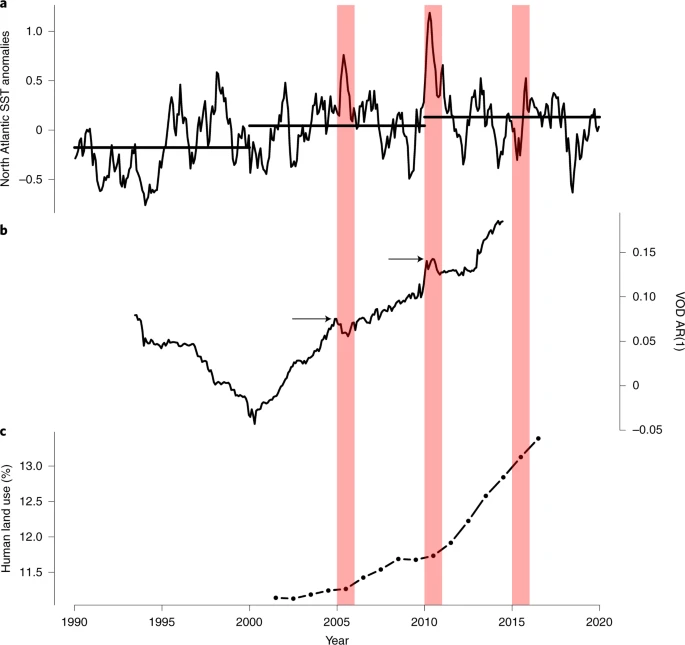
a, Northern tropical Atlantic SST anomalies averaged over xv–70° W, 5–25° N, one time a mean monthly cycle has been removed. Horizontal black lines denote the decade-mean anomalies. b, Spatially averaged Amazon bowl VOD AR(one) fourth dimension series as in Fig. 2, plotted at the midpoint of the window used to calculate AR(1) rather than at the finish of the window. c, Annual time series of percent of grid cells in the Amazon basin that have homo state use (as described in Methods). Red bands refer to 2005, 2010 and 2015, which were severe drought years in the Amazon basin. Arrows in b prove the tiptop value in AR(i) in or about the drought years. These peak values may appear earlier due to the AR(one) time series existence calculated on a moving window, compared to the SST anomalies being a monthly hateful.
Increasing man land use likewise appears to be contributing to the observed Amazon resilience loss, with human land-use areas increasing in both achieve and intensity (Fig. 6c and Supplementary Fig. 14). Notably, the expansion of human land utilize accelerates subsequently 2010, in an interval that also shows accelerated resilience loss (Fig. 6b) just less hitting northern tropical Atlantic SST anomalies (Fig. 6a). Greater proximity to human country utilise tin can increase disturbance factors such as direct removal of copse, construction of roads and fires, feasibly reducing absolute resilience (Fig. five) and making the woods more prone to resilience loss.
Other factors, including rising atmospheric temperatures in response to anthropogenic greenhouse gas emissions, may additionally have negative effects on Amazon resilience (and are contributing to the warming of northern tropical Atlantic SSTs; Fig. 6a). Furthermore, the rapid modify in climate is triggering ecological changes simply ecosystems are having difficulties in keeping footstep. In detail, the replacement of drought-sensitive tree species by drought-resistant ones is happening slower than changes in (hydro)meteorological weather50, potentially reducing woods resilience further.
In summary, nosotros have revealed empirical evidence that the Amazon rainforest has been losing resilience since the early 2000s, risking dieback with profound implications for biodiversity, carbon storage and climate change at a global calibration. Nosotros further provided empirical evidence suggesting that overall drier conditions, culminating in three severe drought events, combined with pronounced increases in human state-use activeness in the Amazon, probably played a crucial role in the observed resilience loss. The amplified loss of Amazon resilience in areas closer to human being land use suggests that reducing deforestation volition not only protect the parts of the wood that are directly threatened merely likewise benefit Amazon rainforest resilience over much larger spatial scales.
Methods
Datasets
We use the Amazon basin (http://worldmap.harvard.edu/information/geonode:amapoly_ivb, accessed 28 Jan 2021) as our region of report. To make up one's mind the grid cells that are independent within Brazil for a subset of assay, we use the 'maps' bundle in R (v.3.three.0; https://CRAN.R-projection.org/package=maps). This is as well used in the plotting of country outlines. The main dataset used to determine forest wellness is from VODCA33, of which we use the Ku-band production. These information are available at 0.25° × 0.25° at a monthly resolution from January 1988 to Dec 2016. We also apply NOAA AVHRR NDVI34. For precipitation data, nosotros use the CHIRPS dataset40 downloaded from Google Earth Engine at a monthly resolution. Finally, to determine country cover types, nosotros used the IGBP MODIS land embrace dataset MCD12C1 (ref. 37). All these datasets are at a higher spatial resolution than the VODCA dataset and thus nosotros downscale them to lucifer the lower resolution. Our SST data comes from HadISST49, where we define a Northward Atlantic region (15–70° West, 5–25° N), for which we accept the spatial mean. The mean monthly cycle is then removed to produce anomalies.
For the vegetation datasets that we mensurate the resilience indicators on (below), nosotros use STL decomposition (seasonal and trend decomposition using Loess)51 using the stl() function in R. This splits time serial in each grid cell into an overall trend, a repeating almanac cycle (past using the 'periodic' selection for the seasonal window) and a residual component. We use the residual component in our resilience analysis. The first iii yr of information had large jumps in VOD which were seen when testing other regions of the world as well as in the Amazon region. Hence, we restrict our assay to the period January 1991 to December 2016.
To test the robustness of the detrending, nosotros too vary the size of the tendency window in the stl() function. The results from these alternatively detrended fourth dimension serial are shown in Supplementary Fig. 4. The results are besides robust to varying the window used to summate the seasonal component rather than using 'periodic'; at the strictest plausible value of 13, we all the same see the aforementioned increases in AR(ane) (Supplementary Fig. 5).
For the AMO index shown in Supplementary Fig. 13, data come from the Kaplan SST dataset and can exist downloaded from https://psl.noaa.gov/information/timeseries/AMO/.
Grid prison cell selection
Nosotros employ the IGBP MODIS land cover dataset at the resolution described to a higher place to determine which filigree cells to use in our analysis. The dataset is available at an annual resolution from 2001 to 2018 (merely we only apply the time series upwards to 2016 to friction match the time span of our VOD and NDVI datasets). To focus on changes in woods resilience, we use grid cells where the evergreen BL fraction is ≥80% in 2001. Grid cells are treated as man land-utilize area if the built-up, croplands or vegetation mosaics fraction is >0%. Nosotros remove grid cells that have human land use in them from our forest assay, regardless of if at that place is ≥80% BL fraction in the grid prison cell.
We measure the minimum distance between forested Amazon basin filigree cells and human land-utilize grid cells in 2016 (believing this to be the most cautious and least biased fashion to measure distance) using the breadth and longitude of each grid signal and calculating the swell-circumvolve altitude. We utilise human country-apply grid cells over a larger area than the bowl, so that nosotros can make up one's mind the closest distance to human land use, regardless of whether this human country use lies within the basin. We likewise measure the minimum distance from man land utilize or roads in Brazil, where we have reliable data on state and federal roads (https://datacatalog.worldbank.org/dataset/brazil-road-network-federal-and-state-highways). As in the main text, we reiterate that these minimum distances can be viewed as the maximum altitude from human country utilise as our information will not include roads for the full Amazon basin, or non-federal or non-country roads in Brazil that volition have homo activeness associated with them.
To ensure that the pattern of changes in resilience is not a event of more settlements beingness in the southeast of the region, combined with the gradient of rainfall from northwest to southeast typical of the rainforest, we measure the correlation between MAP and the distances from the urban grid cells, which is very weak (Spearman'south ρ = 0.109, P < 0.001) and as such we are confident that in that location are split processes that causes these relationships.
Resilience indicator AR(1)
We measure our resilience indicator on the residual component of the decomposed vegetation time series. We focus on AR(i), which provides a robust indicator for CSD before bifurcation-induced transitions and has been widely used for this purpose23,25,32. We mensurate it on a sliding window length equal to five year (60 months). The sliding window creates a time series of the AR(one) coefficient in each location. Our results are robust to the sliding window length used, as shown in Supplementary Fig. six.
From linearization and the illustration to the Ornstein–Uhlenbeck procedure, information technology holds approximately that for discrete fourth dimension steps of width Δt (ane month in the example at hand):
$$\mathrm{AR}\left( one \right) = \mathrm{e}^{\left( { - \kappa {\Delta}t} \correct)},$$
where κ is the linear recovery rate. A decreasing recovery rate κ implies that the system's capability to recover from perturbations is progressively lost, corresponding to diminishing stability or resilience of the attained equilibrium state. From the above equation it is articulate that the AR(ane) increases with decreasing κ. The point at which stability is lost and the system volition undergo a disquisitional transition to shift to a new equilibrium state, corresponds to κ = 0 and AR(1) = one, respectively.
Measuring AR(i) across the whole time series provides information almost the feature time scales of the two vegetation datasets we use26. Inverting κ gives the characteristic fourth dimension scale of the system; for the VOD, nosotros observe 1/κ = 1.240 months, whereas for the NDVI, we observe 1/κ = 0.838 months when using the mean AR(1) value across the region. This suggests that, in accord with our interpretation of the two satellite-derived variables, the NDVI is more sensitive to shorter-term vegetation changes such as leaf greenness, while the VOD'southward Ku-band is sensitive to longer-term changes such as variability in the thickness of forest stems.
Creation and trend of AR(i) and variance time series
For analyses where either MAP bands or distance bands are used to create an AR(1) or variance serial, we calculate the mean AR(1) or variance value in each calendar month for forested (BL ≥ 80%), not-man land-utilise Amazon basin grid cells, from which the trend of this mean serial can exist calculated. Alternatively, the Kendall τ for each band can be calculated by taking the hateful Kendall τ for each private grid prison cell that is within the band. Results from the first option are shown in Figs. 4 and five and results from the 2d method in Supplementary Fig. 15 for AR(1).
The tendencies of the CSD indicators are adamant in terms of Kendall τ. This is a rank correlation coefficient with one variable taken to exist fourth dimension. Kendall τ values of one imply that the time series is always increasing, −1 implies that the time series is always decreasing and 0 indicates that there is no overall tendency. Post-obit previous piece of work25,52,53, nosotros test the statistical significance of positive tendencies using a test based on phase surrogates that preserve both the variance and the serial correlations of the time serial from which the surrogates are constructed. Specifically, nosotros compute the Fourier transform of each fourth dimension series for which nosotros want to test the significance of Kendall τ, and so randomly permute the phases and finally use the changed Fourier transform. Since this preserves the power spectral density, information technology besides preserves the autocorrelation function due to the Wiener–Khinchin theorem. For each time series this procedure is repeated 100,000 times to obtain the surrogates. Kendall τ is computed for each surrogate to obtain the null model distribution (respective to the assumption of the same variance and autocorrelation but no underlying tendency), from which we calculate a P value by computing the proportion of surrogates that accept a higher Kendall τ value.
Robustness tests
To business relationship for the possibility of homo deforestation interfering with the signals nosotros observe (which may not necessarily be detected by the MODIS Land Cover dataset) we likewise use the Hansen wood loss dataset54 to determine grid cells to remove in an alternate analysis. The original Hansen dataset is at a 0.00025° resolution, i,000 times higher than the VOD dataset and as such for each VOD grid cell we measure the percentage of Hansen grid cells that evidence some forest loss over the fourth dimension menstruation. Notation that this dataset does not specify if the observed loss is natural or caused by human deforestation. Excluding whatsoever VOD grid cells that contain more than than a bourgeois five% of lost forest filigree cells according to this dataset and running the analysis in the principal paper shows like results. Supplementary Figs. sixteen–xviii are recreations of Figs. 2, 4 and 5, respectively.
The loss of forest resilience observed as increasing AR(1) in both vegetation indices is supported by another indicator of CSD, namely increasing variance28—of both VOD (Supplementary Fig. 19) and NDVI (Supplementary Fig. 20). Variance is more strongly affected by changes in the frequency and amplitude of the forcing of a system and as such results could be biased towards individual events. Withal, we assessed the precipitation time series for changes in variance and found no relationship with the variance signals of VOD and NDVI (Supplementary Fig. 21). Nonetheless, AR(i) is considered the more robust indicator55. As another test of robustness, we division the filigree cells into those that are in floodplains and those that are not (Supplementary Fig. 3). Floodplain data are part of the NASA Large Scale Biosphere–Atmosphere Experiment (LBA-ECO)56. We also calculate the resilience signals for the C-ring product of VOD for comparison (Supplementary Fig. 22). Despite the smaller temporal scale of this production, we however see increases in both AR(1) and variance. To account for a change in the number of satellites used to calculate VOD, for the Ku-band we likewise recreate the dataset by sampling a single random day per month rather than taking a monthly average, to mimic a abiding satellite laissez passer for the whole time catamenia (Supplementary Fig. 23). Although this expectedly affects the accented values of AR(1) and variance, their relative changes over time remain unaffected. To further examination the robustness of our results, we looked for similar signals of resilience alter in terms of trends in AR(1) in addition to variance in the precipitation fourth dimension series used, as a change in the forcing could have an impact on the wood that could mistakenly be interpreted as a vegetation resilience loss. However, as for the variance, there is no clear increase in the AR(1) of atmospheric precipitation, nor do the spatial patterns of both indicators reveal whatsoever human relationship between changing precipitation AR(one) and variance and the observed vegetation resilience loss. Hence, nosotros are confident that changes in atmospheric precipitation forcing are not driving the vegetation AR(1) signals.
Data availability
Code availability
All data and code used for the assay are available on asking from the respective author and are published online57.
References
-
Lenton, T. G. et al. Tipping elements in the Globe'southward climate system. Proc. Natl Acad. Sci. USA 105, 1786–1793 (2008).
-
Dirzo, R. & Raven, P. H. Global state of biodiversity and loss. Ann. Rev. Environ. Res. 28, 137–167 (2003).
-
Malhi, Y. et al. Climate change, deforestation, and the fate of the Amazon. Scientific discipline 319, 169–172 (2008).
-
Gatti, 50. V. et al. Amazonia as a carbon source linked to deforestation and climatic change. Nature 595, 388–393 (2021).
-
Brienen, R. J. West. et al. Long-term reject of the Amazon carbon sink. Nature 519, 344–348 (2015).
-
Feldpausch, T. R. et al. Amazon forest response to repeated droughts. Glob. Biogeochem. Cycles 30, 964–982 (2016).
-
Hubau, W. et al. Asynchronous carbon sink saturation in African and Amazonian tropical forests. Nature 579, 80–87 (2020).
-
Boers, Northward., Marwan, N., Barbosa, H. M. J. & Kurths, J. A deforestation-induced tipping betoken for the S American monsoon organisation. Sci. Rep. 7, 41489 (2017).
-
Cox, P. M., Betts, R. A., Jones, C. D., Spall, Due south. A. & Totterdell, I. J. Dispatch of global warming due to carbon-bike feedbacks in a coupled climate model. Nature 408, 184–187 (2000).
-
Cox, P. Grand. et al. Increasing hazard of Amazonian drought due to decreasing aerosol pollution. Nature 453, 212–215 (2008).
-
Lovejoy, T. E. & Nobre, C. Amazon tipping point. Sci. Adv. 4, eaat2340 (2018).
-
Lovejoy, T. Eastward. & Nobre, C. Amazon tipping signal: last chance for activity. Sci. Adv. 5, eaba2949 (2019).
-
Brando, P. Thou. et al. Abrupt increases in Amazonian tree mortality due to drought–fire interactions. Proc. Natl Acad. Sci. The states 111, 6347–6352 (2014).
-
Pueyo, Due south. et al. Testing for criticality in ecosystem dynamics: the example of Amazonian rainforest and savanna fire. Ecol. Lett. 13, 793–802 (2010).
-
Salati, E., Dall'Olio, A., Matsui, Eastward. & Gat, J. R. Recycling of water in the Amazon basin: an isotopic study. Water Resour. Res. 15, 1250–1258 (1979).
-
Jones, C., Lowe, J., Liddicoat, S. & Betts, R. Committed terrestrial ecosystem changes due to climate change. Nat. Geosci. ii, 484–487 (2009).
-
Boulton, C. A., Booth, B. B. B. & Good, P. Exploring uncertainty of Amazon dieback in a perturbed parameter Earth organization ensemble. Glob. Modify Biol. 23, 5032–5044 (2017).
-
Huntingford, C. et al. Simulated resilience of tropical rainforests to COtwo-induced climatic change. Nat. Geosci. 6, 268–273 (2013).
-
Friend, A. D., Stevens, A. K., Knox, R. Thousand. & Cannell, Yard. G. R. A process-based, terrestrial biosphere model of ecosystem dynamics (Hybrid v3.0). Ecol. Model. 95, 249–287 (1997).
-
Poulter, B. et al. Robust dynamics of Amazon dieback to climate alter with perturbed ecosystem model parameters. Glob. Modify Biol. xvi, 2476–2495 (2010).
-
Sitch, South. et al. Evaluation of the terrestrial carbon wheel, future establish geography and climate-carbon cycle feedbacks using five Dynamic Global Vegetation Models (DGVMs). Glob. Change Biol. xiv, 2015–2039 (2008).
-
Wissel, C. A universal law of the characteristic return fourth dimension well-nigh thresholds. Oecologia 65, 101–107 (1984).
-
Scheffer, Thousand. et al. Early-warning signals for disquisitional transitions. Nature 461, 53–59 (2009).
-
Pimm, Southward. Fifty. The complexity and stability of ecosystems. Nature 307, 321–326 (1984).
-
Dakos, V. et al. Slowing downwards equally an early warning point for abrupt climatic change. Proc. Natl Acad. Sci. The states 105, 14308–14312 (2008).
-
Held, H. & Kleinen, T. Detection of climate organisation bifurcations by degenerate fingerprinting. Geophys. Res. Lett. https://doi.org/10.1029/2004gl020972 (2004).
-
Boulton, C. A., Good, P. & Lenton, T. M. Early warning signals of fake Amazon rainforest dieback. Theor. Ecol. half-dozen, 373–384 (2013).
-
Lenton, T. G. Early warning of climate tipping points. Nat. Clim. Change 1, 201–209 (2011).
-
Biggs, R., Carpenter, S. R. & Brock, W. A. Turning dorsum from the brink: detecting an impending regime shift in time to avert it. Proc. Natl Acad. Sci. USA 106, 826–831 (2009).
-
Boers, Due north. & Rypdal, M. Critical slowing down suggests that the western Greenland Ice Canvas is close to a tipping indicate. Proc. Natl Acad. Sci. USA 118, e2024192118 (2021).
-
Boers, North. Observation-based early-alert signals for a collapse of the Atlantic Meridional Overturning Circulation. Nat. Clim. Change 11, 680–688 (2021).
-
Verbesselt, J. et al. Remotely sensed resilience of tropical forests. Nat. Clim. Change 6, 1028–1031 (2016).
-
Moesinger, L. et al. The global long-term microwave Vegetation Optical Depth Climate Annal (VODCA). Earth Syst. Sci. Data 12, 177–196 (2020).
-
NOAA Climate Data Tape (CDR) of AVHRR Normalized Deviation Vegetation Index (NDVI), Version five (NOAA National Centers for Environmental Information, accessed x Feb 2021); https://doi.org/10.7289/V5ZG6QH9
-
Liu, Y. Y. et al. Recent reversal in loss of global terrestrial biomass. Nat. Clim. Change five, 470–474 (2015).
-
Myneni, R. B., Keeling, C. D., Tucker, C. J., Asrar, Thou. & Nemani, R. R. Increased plant growth in the northern high latitudes from 1981 to 1991. Nature 386, 698–702 (1997).
-
Friedl, Yard. & Sulla-Menashe, D. MCD12C1, Version six (NASA EOSDIS Land Processes DAAC, accessed twenty April 2020); https://doi.org/10.5067/MODIS/MCD12C1.006
-
Tian, F. et al. Remote sensing of vegetation dynamics in drylands: evaluating vegetation optical depth (VOD) using AVHRR NDVI and in situ greenish biomass information over W African Sahel. Remote Sens. Environ. 177, 265–276 (2016).
-
Flores, B. M. et al. Floodplains as an Achilles' heel of Amazonian forest resilience. Proc. Natl Acad. Sci. U.s. 114, 4442–4446 (2017).
-
Funk, C. et al. The climate hazards infrared precipitation with stations—a new environmental record for monitoring extremes. Sci. Data 2, 150066 (2015).
-
Wuyts, B., Champneys, A. R. & Firm, J. I. Amazonian forest–savanna bistability and human impact. Nat. Commun. 8, 15519 (2017).
-
Fu, R. et al. Increased dry-season length over southern Amazonia in recent decades and its implication for future climate projection. Proc. Natl Acad. Sci. United states 110, 18110–18115 (2013).
-
Marengo, J. A. et al. Changes in climate and land utilize over the Amazon region: current and future variability and trends. Front. Earth Sci. https://doi.org/ten.3389/feart.2018.00228 (2018).
-
Leite-Filho, A. T., Sousa Pontes, V. Y. & Costa, M. H. Effects of deforestation on the onset of the rainy flavour and the duration of dry spells in southern Amazonia. J. Geophys. Res. Atmos. 124, 5268–5281 (2019).
-
Leite‐Filho, A. T., Costa, M. H. & Fu, R. The southern Amazon rainy season: the role of deforestation and its interactions with large‐scale mechanisms. Int. J. Climatol. https://doi.org/10.1002/joc.6335 (2019).
-
Lewis, S. L., Brando, P. M., Phillips, O. L., Van Der Heijden, K. K. F. & Nepstad, D. The 2010 Amazon drought. Science 331, 554 (2011).
-
Erfanian, A., Wang, G. & Fomenko, L. Unprecedented drought over tropical Southward America in 2016: significantly nether-predicted past tropical SST. Sci. Rep. 7, 5811 (2017).
-
Ciemer, C. et al. An early-warning indicator for Amazon droughts exclusively based on tropical Atlantic sea surface temperatures. Environ. Res. Lett. 15, 094087 (2020).
-
Rayner, N. A. et al. Global analyses of sea surface temperature, sea ice, and dark marine air temperature since the late nineteenth century. J. Geophys. Res. https://doi.org/10.1029/2002jd002670 (2003).
-
Esquivel‐Muelbert, A. et al. Compositional response of Amazon forests to climate change. Glob. Change Biol. 25, 39–56 (2019).
-
Cleveland, R. B., Cleveland, W. S. & Terpenning, I. STL: a seasonal-trend decomposition process based on Loess. J. Off. Stat. 6, 3 (1990).
-
Rypdal, Chiliad. Early-warning signals for the onsets of Greenland interstadials and the younger dryas–preboreal transition. J. Clim. 29, 4047–4056 (2016).
-
Boers, N. Early-warning signals for Dansgaard–Oeschger events in a high-resolution ice core record. Nat. Commun. 9, 2556 (2018).
-
Hansen, M. C. et al. Loftier-resolution global maps of 21st-century forest cover alter. Science 342, 850–853 (2013).
-
Dakos, V., Van Nes, E. H., D'Odorico, P. & Scheffer, One thousand. Robustness of variance and autocorrelation as indicators of critical slowing down. Ecology 93, 264–271 (2012).
-
Hess, Fifty. Fifty. et al. LBA-ECO LC-07 Wetland Extent, Vegetation, and Overflowing: Lowland Amazon Basin (ORNL DAAC, 2005); https://doi.org/10.3334/ORNLDAAC/1284
-
Boulton, C. A. Amazon rainforest resilience data. Zenodo https://doi.org/10.5281/zenodo.5837469 (2022).
Acknowledgements
We thank B. Sakschewski for his helpful comments on the inquiry. N.B. acknowledges funding past the Volkswagen Foundation. This is TiPES contribution no. 107. The TiPES project ('Tipping Points in the Earth System') has received funding from the European Spousal relationship'south Horizon 2020 inquiry and innovation program under grant agreement no. 820970. C.A.B. and T.M.L. were supported past the Leverhulme Trust (RPG-2018-046). T.M.L. was also supported past a grant from The Alan Turing Institute under a Turing Fellowship (R-EXE-001).
Author information
Affiliations
Contributions
N.B. and C.A.B. conceived and designed the written report with input from T.M.L. C.A.B. performed the numerical analysis with contributions from Northward.B. All authors discussed and interpreted results, drew conclusions and wrote the newspaper.
Corresponding writer
Ethics declarations
Competing interests
The authors declare no competing interests.
Peer review
Peer review information
Nature Climate Modify thanks Albertus J. Dolman, Bernardo Flores and the other, anonymous, reviewer(s) for their contribution to the peer review of this piece of work.
Additional information
Publisher's notation Springer Nature remains neutral with regard to jurisdictional claims in published maps and institutional affiliations.
Supplementary data
Rights and permissions
Open Access This article is licensed under a Artistic Commons Attribution 4.0 International License, which permits use, sharing, adaptation, distribution and reproduction in any medium or format, equally long as you give appropriate credit to the original author(s) and the source, provide a link to the Artistic Commons license, and signal if changes were made. The images or other third party cloth in this article are included in the article's Creative Commons license, unless indicated otherwise in a credit line to the material. If material is not included in the article'south Creative Commons license and your intended use is not permitted past statutory regulation or exceeds the permitted utilise, you volition need to obtain permission straight from the copyright holder. To view a copy of this license, visit http://creativecommons.org/licenses/by/iv.0/.
Reprints and Permissions
About this article

Cite this article
Boulton, C.A., Lenton, T.M. & Boers, N. Pronounced loss of Amazon rainforest resilience since the early 2000s. Nat. Clim. Chang. 12, 271–278 (2022). https://doi.org/x.1038/s41558-022-01287-8
-
Received:
-
Accepted:
-
Published:
-
Consequence Date:
-
DOI : https://doi.org/x.1038/s41558-022-01287-8
Farther reading
Source: https://www.nature.com/articles/s41558-022-01287-8
0 Response to "When Will Ohio Turn Into a Rainforest Again"
Post a Comment